
What Is Agentic Onboarding in Wealth Management?
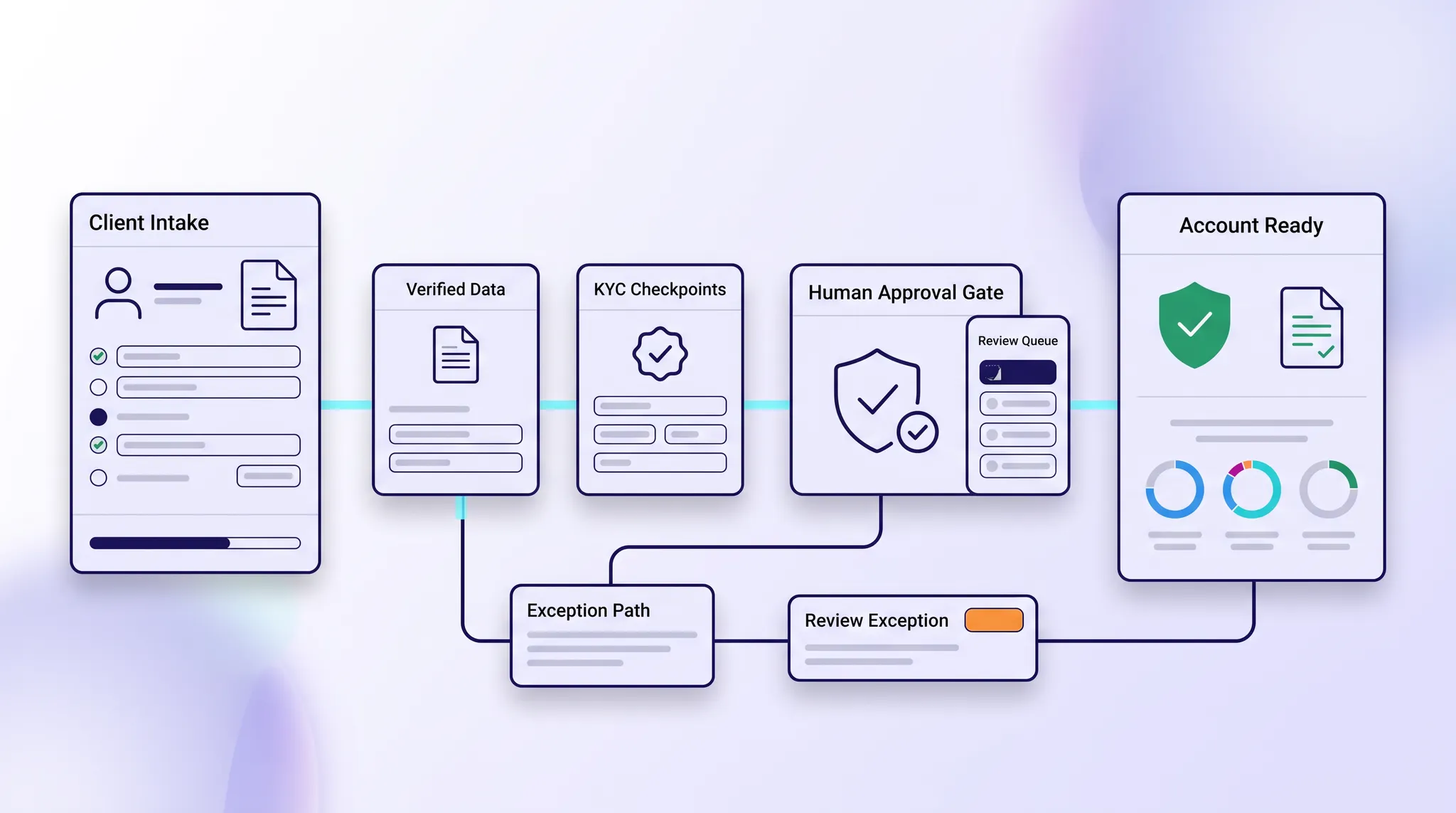
Agentic onboarding coordinates the work between client intake and an account-ready outcome. Learn how it differs from forms, automation, and copilots—and what a controlled workflow requires.
Agentic onboarding is a client-onboarding operating model in which an AI agent coordinates a multi-step workflow toward a defined outcome. Instead of waiting for a person to move information between forms, systems, queues, and reviewers, the agent can gather and reuse data, invoke approved tools, route tasks, apply configured rules, and maintain status across the process.
The important word is coordinates. Agentic onboarding does not mean that an AI system makes every decision or operates without boundaries. In a controlled wealth-management workflow, the firm defines what the agent may do, which information it may use, when a person must review the case, and what evidence must remain after each action.
That makes agentic onboarding different from a digital form, a fixed automation, or an AI copilot. It is an operating layer for moving a client from initial intent toward an account-ready outcome while preserving the firm’s required controls.
Agentic onboarding versus ordinary automation
These approaches can coexist, but they do different jobs:
| Approach | What it does | Where coordination lives |
|---|---|---|
| Digital form | Captures information electronically | People move the case between later steps |
| Rules-based automation | Performs a predefined action after a trigger | People manage the broader workflow and exceptions |
| AI copilot | Summarizes, drafts, or recommends | A person decides and executes each next step |
| Agentic onboarding | Pursues a defined workflow outcome across connected steps and systems | The agent coordinates within configured authority and escalates required decisions |
A digitized process can still be manual end to end. If operations must re-enter client data, an advisor must chase an approval, or compliance must reconstruct status from email and several applications, the form is online but the workflow remains disconnected.
How an agentic onboarding workflow operates
A useful way to evaluate the concept is to follow one case from initiation through completion.
1. Establish the objective and context
The workflow begins with a defined outcome, such as preparing a new client and household for account opening. The case also needs context: who initiated it, which client and account structures are involved, which business unit owns it, and which policies apply.
On OneVest, onboarding can begin through the client, an advisor, or an operations team while following a shared workflow (OneVest Onboarding). The initiation path can differ without creating separate operating models for each team.
2. Capture and validate information
The agent gathers available information from approved sources and identifies what is missing. That may include uploaded documents, meeting notes, existing client records, custodian data, or connected systems.
The objective is not merely to prefill more fields. The workflow should preserve where material information came from, validate required inputs, and surface conflicts before they reach a later stage. FinRegLab’s market scan on agentic AI in financial services notes that agentic systems depend on access to clean, consistent, current data; incomplete or stale context can reduce their value and increase risk (FinRegLab).
3. Assemble the next steps
A fixed workflow always follows the same path. An agentic workflow can choose among approved next actions based on the case state.
For example, it may determine that the household record is complete but identity information is missing, or that an account type requires an additional document and a designated review. The available paths still come from the firm’s configured rules. The agent is coordinating known tools and controls, not inventing policy.
4. Invoke approved systems and tools
The agent then performs the actions it is authorized to take: populate an application, request a document, initiate a verification step, create a task, or send a case to an approved downstream system.
This is where architecture matters. Agentic onboarding cannot operate as an isolated AI feature if the real process spans client data, applications, compliance checks, approvals, and custodian connections. OneVest’s Account Opening connects those elements in a single application workflow, while the broader OneVest Platform provides the orchestration layer across workspaces, data, and integrations.
5. Apply rules and route approvals
Not every action should execute automatically. The firm must define where progression is allowed, where a warning is sufficient, and where a person must approve the case.
The agent can evaluate configured conditions, attach the relevant information, and route a review to the right role. It should also prevent progression when a required approval has not been recorded.
NIST’s AI Risk Management Framework treats governance as a continuous function and emphasizes that trustworthy AI characteristics—including validity, security, accountability, transparency, privacy, and fairness—must be evaluated in context (NIST AI RMF). For onboarding, that means authority and review requirements should reflect the consequence of the action rather than relying on one blanket automation setting.
6. Manage exceptions and human decisions
The exception path is the real test of agentic onboarding. Missing information, failed checks, policy conflicts, unusual household structures, or reviewer questions should not force the case into an email thread with no shared status.
A controlled workflow should identify the exception, assign an owner, preserve the relevant evidence, and define what happens after the person resolves it. Human involvement is therefore selective but explicit: people handle judgment, exceptions, approvals, and policy decisions while the agent coordinates the surrounding work.
The Monetary Authority of Singapore’s SAFR paper offers an industry reference model—not regulatory guidance—for governing agent actions at runtime. It describes a checkpoint between a proposed action and execution using agent identity, applicable controls, a disposition decision, and an append-only audit record (MAS SAFR). The practical lesson is straightforward: oversight should be built into the action path, not added after an incident.
7. Close the loop
The workflow should end with a clear case state and a complete history: information used, checks completed, actions taken, approvals recorded, exceptions resolved, and systems updated.
That shared state matters to every participant. The client needs to know what remains. The advisor needs to understand progress without chasing operations. Reviewers need the case evidence. Leaders need visibility into where work is slowing or repeatedly producing exceptions.
The Advisor Workspace connects onboarding activity to the broader client context so advisors, operations, and the home office can work from the same live workflow rather than separate status views.
Four tests for agentic onboarding
A platform may use AI without delivering an agentic operating model. Test it with four questions.
Is the authority bounded?
Can the firm specify what the agent may initiate, change, submit, or approve? Can those boundaries vary by role, account type, jurisdiction, or workflow stage?
Is the data connected and traceable?
Can the platform show which source populated a material field, whether it was validated, and how a correction moved through the case?
Are human decision points explicit?
Can the vendor demonstrate a case that cannot progress until the designated person reviews it? Does the reviewer receive the facts, policy context, and evidence needed to decide?
Is the history complete?
Can the firm reconstruct the sequence of automated and human actions without combining logs from several systems after the fact?
If the answer to these questions is unclear, the platform may offer helpful AI features while leaving the firm responsible for manual coordination.
What agentic onboarding changes
The most important change is not that AI appears in the onboarding interface. It is that coordination becomes part of the system.
Data can move forward without repeated entry. Routine actions can occur when their conditions are met. Reviews can arrive with the right context. Exceptions can stay inside a shared case. Advisors and clients can see progress without asking operations to reconstruct it.
The firm still owns the workflow, policies, decisions, and oversight. The agent’s role is to execute and coordinate within those boundaries so people can focus on the moments that require judgment.
See Agentic Onboarding in action
See how OneVest connects client data, KYC, approvals, exceptions, and account-opening steps in one controlled onboarding workflow.