
Wealth Management Reporting Software: 8 Questions to Ask
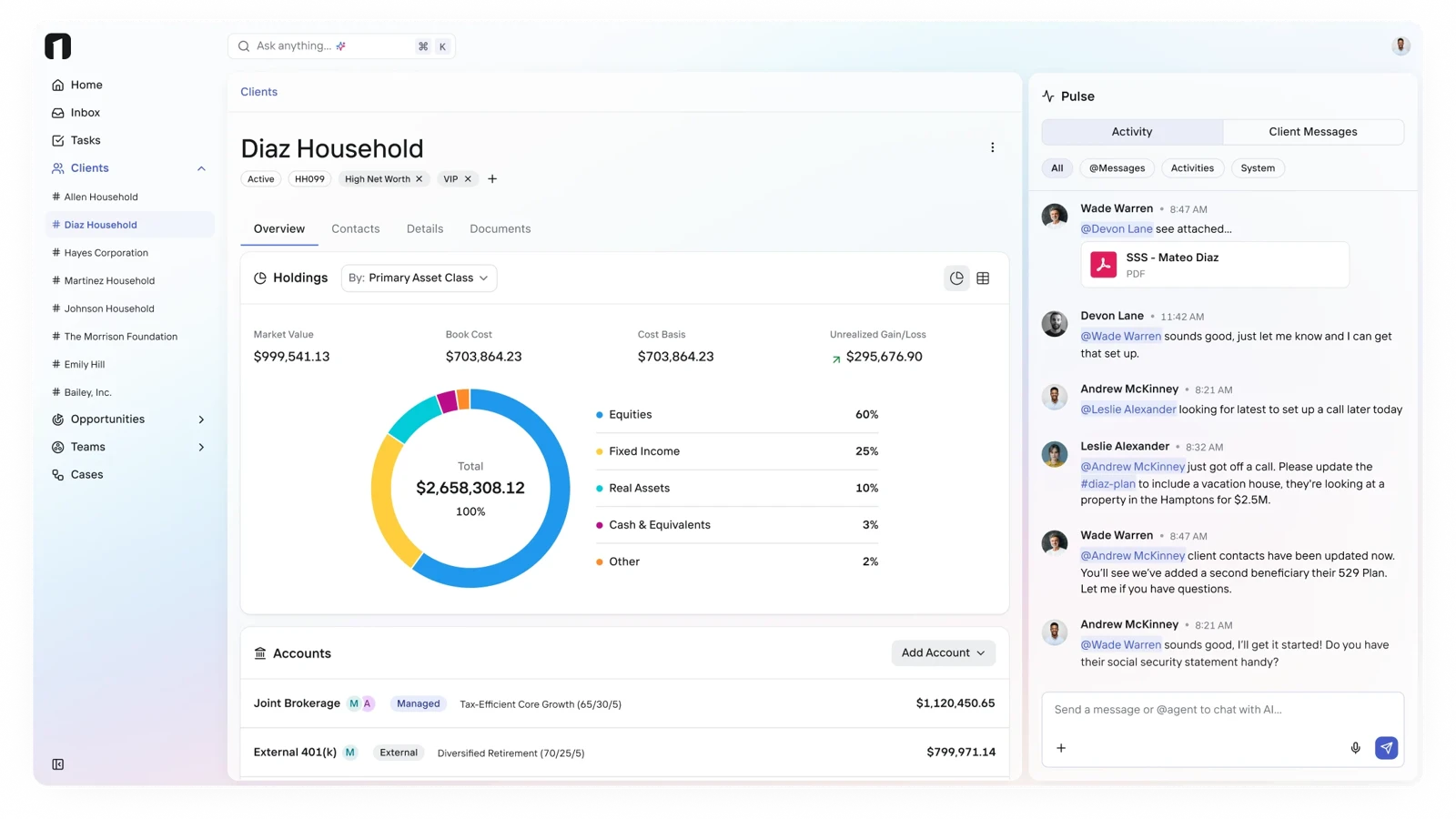
Use eight questions to evaluate wealth management reporting software across data lineage, calculations, permissions, delivery, corrections, and firm-wide rollups.
Wealth management reporting software should do more than generate a dashboard or branded PDF. It should show where each number came from, how it was calculated, which accounts and entities it includes, who approved it, when it was delivered, and what changed after a correction.
That operating chain matters because wealth reports often combine data from custodians, portfolio systems, CRMs, client records, and external sources. A polished output can still be unreliable if the underlying data is stale, the calculation logic is inconsistent, or the delivery record is incomplete.
Use these eight questions to evaluate a reporting engine before it becomes part of a client, operational, management, or regulatory process.
1. Which systems supply each number?
Start with source lineage. For every material field, the platform should identify the originating system, account, effective date, and last update time.
Ask how the reporting engine handles:
- Custodian positions and cash balances.
- Portfolio-system performance data.
- CRM and household records.
- Fees, transactions, and tax lots.
- Held-away assets and manually entered values.
- Data received through files, APIs, or event streams.
A report should make stale or unavailable data visible. “Current” needs a defined timestamp and source, not a green status label.
OneVest describes a connected platform that brings custodians, CRMs, portfolio systems, and other data sources into one operating layer. The OneVest platform lists reporting and business intelligence alongside connected workflows and workspaces.
2. How are calculations defined and governed?
Two reports can use the same raw data and still produce different results. The difference may come from timing, cash-flow treatment, fee handling, currency conversion, benchmarks, household rules, or rounding.
Request a data dictionary and calculation specification for each important measure. Review:
- Formula and methodology.
- Gross or net treatment.
- Time period and valuation point.
- Cash-flow timing.
- Currency and conversion source.
- Benchmark definition.
- Rounding and display rules.
- Version and effective date.
Business users should not be able to change a governed calculation without review. At the same time, the firm should not need engineering work to adjust an approved layout or select a permitted field.
3. Can the platform explain every rollup?
Wealth firms report at several levels, including account, household, advisor, branch, legal entity, region, and enterprise. The platform should preserve those boundaries while producing a clear consolidated view.
Ask the vendor to show how a total is derived. A user should be able to move from the aggregate value to the accounts and components that produced it.
This is especially important for multi-entity firms. FINRA’s Rule 2231 says covered summary statements must clearly distinguish assets held by each entity and make aggregated values recognizable as arithmetically derived from the underlying totals or components.
For an RIA aggregator, test whether the system can produce both a firm-specific view and a network-wide view without exposing data across organizational boundaries. OneVest’s RIA Aggregators page describes reporting for a single firm or an entire network, with organizational scoping and scheduled delivery.
4. How are externally held assets labeled?
A complete wealth view may include assets that the firm or broker-dealer does not carry. Those values need different treatment from positions held on the firm’s books.
Evaluate whether the platform can preserve:
- The external source.
- The value date.
- The valuation method.
- The responsible party.
- Required disclosures.
- A clear visual separation from carried assets.
FINRA Rule 2231 requires externally held assets on covered customer statements to be clearly separated and identified as externally sourced. Its related Regulatory Notice 23-02 explains the disclosure and summary-statement controls that took effect in 2024.
The exact obligation depends on the firm, report, recipient, and registration. The software should support the firm’s approved treatment rather than assume every asset belongs in one undifferentiated total.
5. Who can build, approve, and receive a report?
Reporting permissions should match the firm’s operating structure. The person who creates a template may not be the person who approves a calculation, changes a disclosure, or releases a client report.
Review:
- Role-based access by firm, team, advisor, and account.
- Template creation and publishing rights.
- Approval requirements for material changes.
- Segregation between preparation and release.
- Access to personally identifiable information.
- Temporary access and access removal.
- Logs for changes, approvals, and downloads.
The OneVest Operations Workspace describes firm-wide visibility, governed workflows, role-based work, and audit-ready reporting for home-office teams. Buyers should confirm how those controls apply to their exact reporting process.
6. Can teams configure reports without weakening controls?
A reporting tool should let authorized users select approved data points, adjust layouts, apply firm branding, and schedule outputs. It should not let each team redefine core measures or remove required disclosures without oversight.
OneVest’s product update on configurable, branded reporting describes no-code tools for selecting data points, customizing layouts, and applying firm branding.
During evaluation, ask the vendor to separate three types of change:
- Presentation changes, such as layout and branding.
- Content changes, such as permitted fields and sections.
- Governed logic changes, such as calculations and disclosures.
Each type should have the right permissions, testing, and approval path.
7. What evidence proves delivery?
Generating a report is not the same as delivering it. The system should record the recipient, delivery method, time, version, status, and any failure or retry.
For scheduled reporting, test:
- Recipient and account eligibility.
- Electronic-delivery preferences or consent where applicable.
- Failed email or portal delivery.
- Duplicate prevention.
- Replacement after a correction.
- Retention of the exact delivered version.
- Evidence that a recipient accessed the report, if the process requires it.
The OneVest Asset Managers page describes scheduled branded reports with a delivery record. Ask to see how that record behaves when a delivery fails, a recipient changes, or a report is replaced.
8. How are corrections and restatements handled?
Errors will occur. A controlled platform should correct them without erasing the history.
Ask the vendor to demonstrate a report after a late custodian update or calculation change. The platform should preserve:
- The original report.
- The reason for correction.
- The person who made and approved the change.
- The revised data or methodology.
- The replacement version.
- The recipients affected.
- The new delivery record.
SEC custody guidance emphasizes reconciliation and complete, accurate, and timely client reporting in the controls surrounding custody and account statements. The SEC’s accountant guidance under Rule 206(4)-2 specifically identifies client reporting and reconciliation among the relevant control areas.
Run a proof-of-report test
Before selecting a platform, build one realistic report that crosses systems and organizational boundaries.
Use a household with several accounts, one externally held asset, a recent cash flow, a changed client address, and a late source update. Then verify that the platform can:
- Trace each value to its source and timestamp.
- Apply the approved calculation version.
- Produce account, household, and firm-level views.
- Keep externally held assets distinct.
- Route the report through the right approval.
- Deliver it to the correct recipient.
- Record the exact version delivered.
- Correct and reissue it without deleting history.
Evaluate the reporting process, not the template
The visible report is only the final output. The more important question is whether the platform governs the data, calculations, access, delivery, and correction process behind it.
OneVest connects reporting with client, advisor, and operations experiences across a modular wealth operating system. Firms can configure branded outputs while keeping reporting connected to the data and workflows that support them.