
How to tell if an AI platform for RIAs will scale
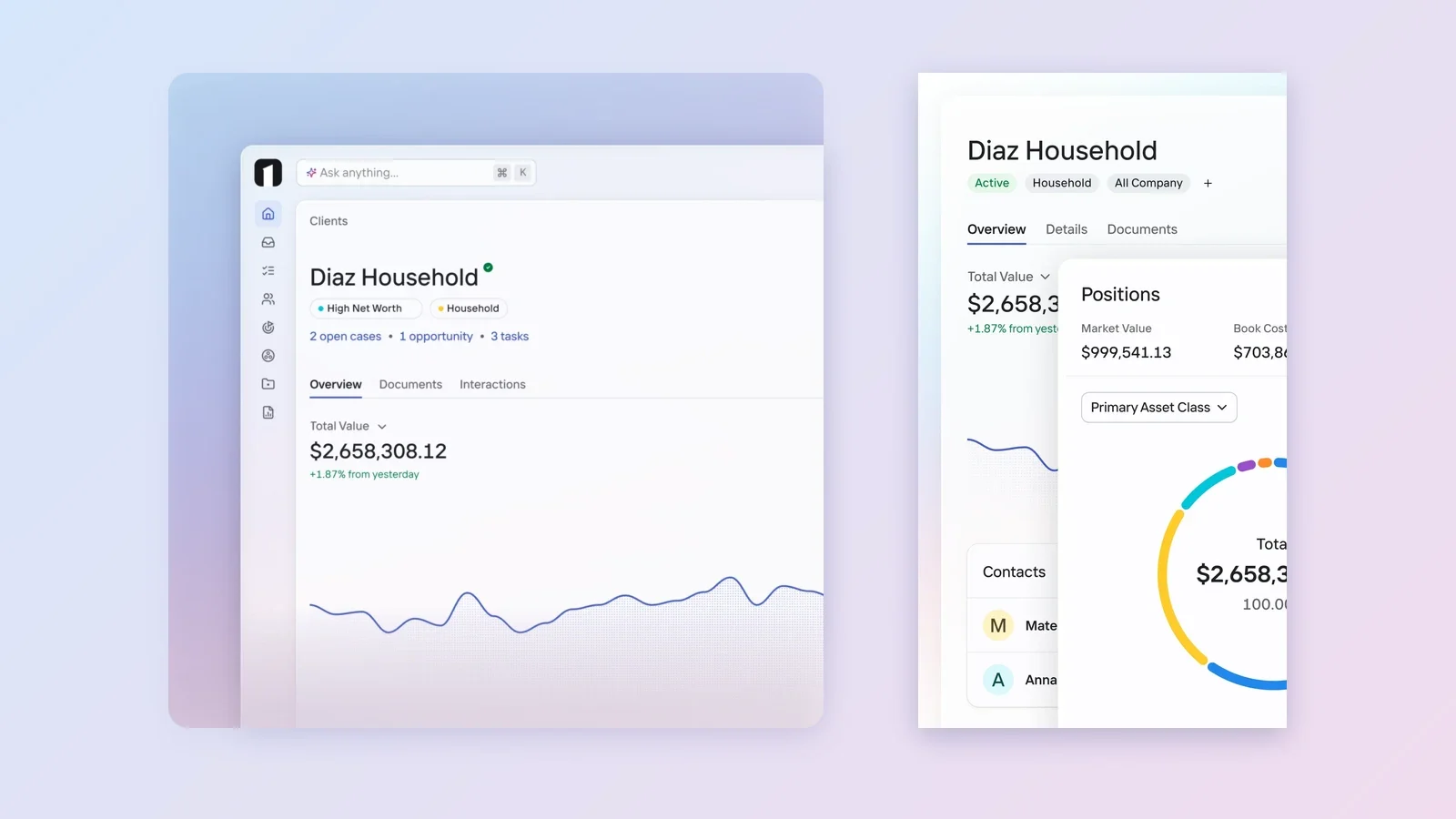
Five practical stress tests RIA leaders can run to see whether an AI platform will hold up as the firm adds advisors, custodians, data and AI activity.
Most AI platforms for RIAs look capable in a demo with a dozen sample households. Scalability shows up later, when the firm adds an advisor team, acquires a practice on a different custodian, or asks an AI assistant to handle hundreds of requests a week. The useful question for a buying committee is what breaks first as the firm grows, and whether the platform's data model, permissions and audit trail were designed for that growth.
This guide covers five stress tests RIA leaders can run during an evaluation. It narrows in on scale; our buyer's guide to AI-native wealth management platforms covers the full set of selection criteria.
Why scale is the hard part of AI for an RIA
Growth adds complexity faster than it adds clients. Kitces Research's 2025 AdvisorTech study found that a typical advisory firm spends 4% to 6% of annual revenue on technology and runs 12 software applications to cover 20 business functions (Kitces Research). The study, which surveyed more than 700 advisors, named integration as one of five key drivers of tech-stack satisfaction. Firms that were more sophisticated in how they integrated and managed their stack rated their satisfaction higher, averaging 8 out of 10 at the top level compared with 7 at the lowest (Financial Planning).
Acquisitions add another layer. ECHELON Partners counted 466 RIA transactions in 2025, a new high and 27% more than in 2024. Firms with less than $1 billion in assets made up 54% of announced deals (ECHELON Partners). Each deal can bring a new custodian, a new CRM export and a new set of client records to reconcile.
AI raises the stakes because it acts on whatever data and access it is given. When client records are split across systems, an assistant summarizes an incomplete picture. When access rules are loose, an assistant can reach records its user should never see.
Stress test 1: add an advisor team or an acquired practice
Ask the vendor to walk through onboarding a 15-advisor team that brings its own book of business. Useful questions:
- How are the new households mapped into existing client records, and how are duplicates handled?
- Can the new team's book be scoped so its advisors see only their own clients on day one?
- Do AI summaries and activity feeds work on imported history, or only on data created after go-live?
A platform built for growth treats a new team as configuration on the same data model. A platform that struggles here usually needs a separate instance, a manual migration project or custom reports for every new office.
Stress test 2: connect another custodian or data source
Many growing RIAs end up on more than one custodian, especially after an acquisition. Test whether custodial, CRM and planning data land in one client record, and ask for the list of live integrations available in your market. Then ask what the AI does when a feed is late or a field is missing. An assistant that flags gaps is safer than one that answers as if the data were complete.
In OneVest Core, custodian, CRM and planning data come together in a single client record, and supported custodians connect without a full replacement of existing systems. Current integrations include Schwab, Fidelity, Apex, Salesforce (bi-directional), Orion and Envestnet, with availability varying by provider and market (OneVest Integrations).
Stress test 3: grow headcount without loosening permissions
Permissions that work for eight people often break at eighty. As a firm adds associates, paraplanners, operations staff and compliance reviewers, each role needs a different view of client data. Ask:
- Are roles enforced at the API level, or only hidden in the interface?
- Can books of business be scoped to teams or offices?
- Does single sign-on support the identity provider your IT team already uses?
This matters more once AI is involved. An assistant that inherits an administrator's access can surface records a junior employee was never meant to see.
OneVest uses Viewer, Member and Admin roles, with permissions enforced through the API and books of business scoped by team. The platform is SOC 2 Type II, and SSO with SAML and OIDC is included in every package (Compare packages).
Stress test 4: run AI at volume with a clear audit trail
A few AI-drafted notes a day are easy to check by hand. Thousands of AI actions a month need structure. FINRA's 2026 oversight report describes AI agents as systems that can plan, make decisions and take actions toward a goal. It lists risks such as agents acting beyond their intended scope and multi-step reasoning that is hard to trace, and it suggests monitoring agent access and data handling, keeping humans in the loop and tracking agent actions (FINRA). That report is written for broker-dealers, but its questions work as a checklist for any advisory firm. For RIAs, the SEC's Division of Examinations says it will review the accuracy of firms' representations about their AI capabilities and whether firms have adequate policies and procedures to monitor or supervise their use of AI (SEC).
During a demo, ask the vendor to show:
- Whether the AI can do anything its user cannot.
- Whether AI actions and human actions are written to the same audit log.
- How the AI confirms what it did.
- Where client data is processed, and whether it is used to train models.
In OneVest, the AI acts on instructions given in chat, such as creating tasks or logging notes, and confirms what it did. It can only do what its user can do, organization settings can narrow that further, and every human or AI action is recorded in the audit log. Models are hosted on Vertex, client data is processed in the US or Canada, and it is not used to train models (AI at OneVest).
Stress test 5: extend the platform through APIs and MCP
Growing firms eventually want to connect tools the vendor did not build, such as a reporting model, an internal data warehouse or an outside AI assistant. Ask whether APIs are included or sold as an add-on, whether webhooks exist for event-driven workflows, and whether the platform supports the Model Context Protocol (MCP) with scoped access. Scope matters because an outside AI client should get only the access a specific job requires. Our post on MCP permissions in wealth management covers how to set those boundaries.
OneVest Core includes APIs, developer tools, MCP and webhooks, and each MCP token carries specific scopes (OneVest Core).
A simple scorecard for your evaluation
Score each stress test on one of three levels during demos:
- Works today: the vendor showed it live on realistic data.
- Configurable: it works with setup or services time. Ask for the estimate in writing.
- Roadmap or custom: it depends on a future release or custom development.
Give tests 3 and 4 extra weight if your firm plans to expand its use of AI. Permissions and audit logging apply to every user and every AI action once the platform is live, so gaps there grow with the firm.
Where OneVest Core fits
OneVest Core is the foundation package of OneVest's AI-native wealth platform, built for firms serving 100 or more clients. It brings custodian, CRM and planning data into one client record and adds Pulse, a shared timeline where AI summarizes client activity and surfaces what needs attention. AI assistance, APIs, MCP, role-based access and SSO are included. Firms that also need a client portal and messaging, or workflows for account opening and money movement, can compare the Engage and Operate packages.
Sources
- Kitces Research, The Technology That Independent Financial Advisors Actually Use (And Like), 2025
- Financial Planning, Higher-value client tech beats expanding capacity
- ECHELON Partners, 2025 RIA M&A Deal Report
- FINRA, 2026 Annual Regulatory Oversight Report: GenAI
- SEC Division of Examinations, Fiscal Year 2026 Examination Priorities
- OneVest, Core, AI at OneVest, Integrations and Compare packages