
How to scale payment automation in wealth management with AI
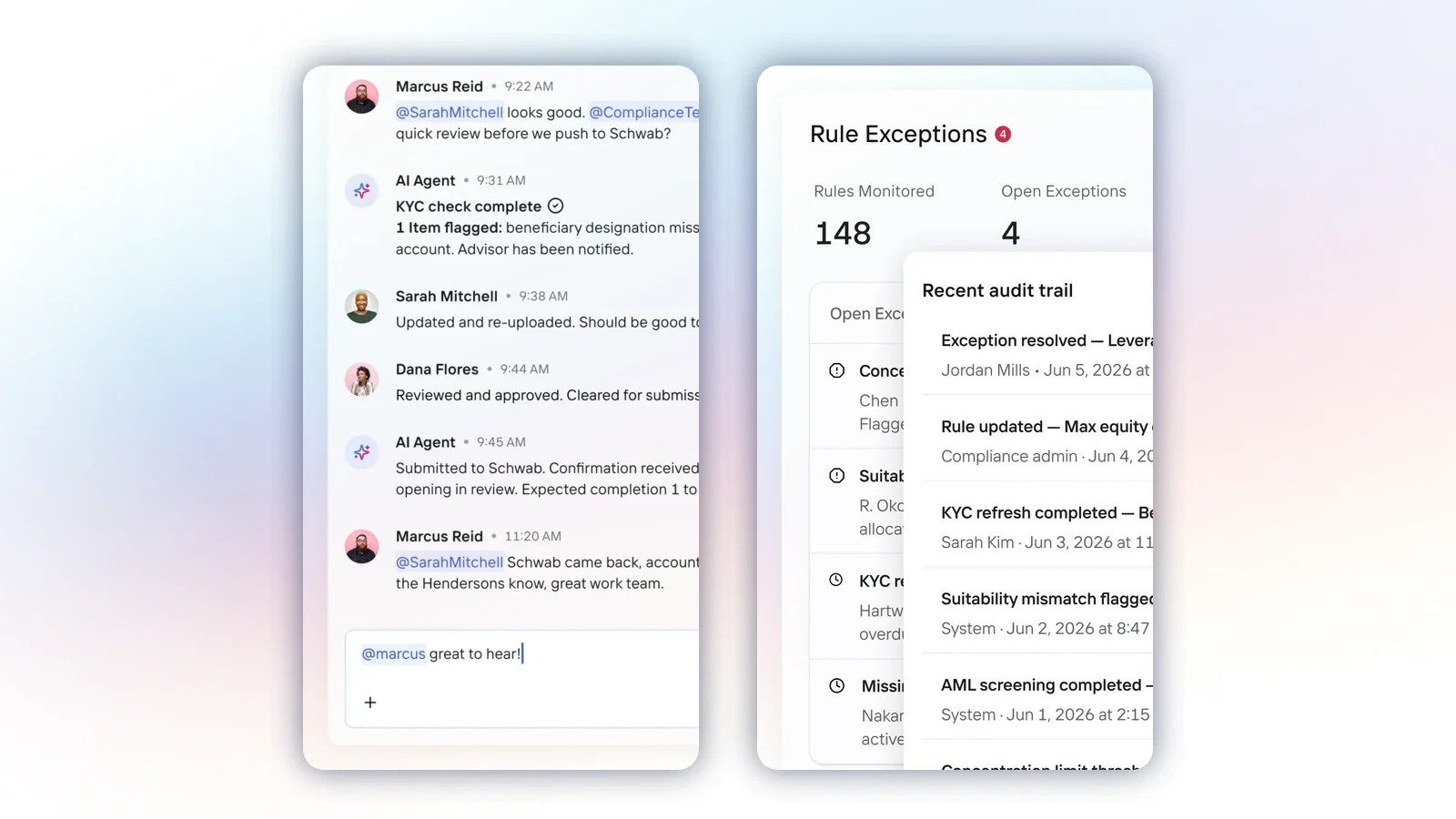
AI can sort payment requests, check them against standing instructions and track custodian responses. Here is how to scale payment automation while people keep control of destinations.
Payment automation in a wealth firm scales when AI takes over the preparation, checking and tracking around each money movement, and people keep the authority to change destinations and release anything outside policy. Most firms hit a ceiling because every contribution, withdrawal and third-party payment passes through the same manual review, whether it is a routine monthly transfer or a first-time wire to a new bank account. AI can sort those requests, assemble the evidence and watch the custodian response. It should not be the party that decides where client money goes.
This guide explains why payment workflows stall as volume grows, what AI changes in each step, where its authority should stop, and a five-step plan to scale without loosening controls. For the underlying control checklist, see our guide to money movement workflow controls.
Why payment workflows stop scaling
Three patterns show up in most operations teams.
First, instructions arrive in many forms. A client emails, an advisor forwards a note, a form comes back signed, and someone re-keys the amount and destination into a custodian portal. Each re-entry is a chance for error and a gap in the record.
Second, review effort is flat. When every request gets the same treatment, a reviewer spends as long on a scheduled contribution as on a changed beneficiary bank. Queue time grows in step with volume, so the only lever left is headcount.
Third, status lives somewhere else. After submission, operations checks the custodian portal, answers the advisor and updates the client. A timeout or partial response can lead to a second submission of the same instruction.
The fraud environment adds pressure. The FBI's 2025 Internet Crime Report recorded 24,768 business email compromise complaints with losses of about $3.05 billion. FinCEN's alert on deepfake fraud schemes describes criminals using generative AI to create falsified identity documents, photos and video to get past verification. A familiar voice on the phone or a convincing email is weaker evidence than it was a few years ago.
Payment networks are responding. Nacha's fraud monitoring rules require originating banks and non-consumer originators, third-party service providers and third-party senders to run risk-based processes reasonably intended to identify ACH entries that are unauthorized or authorized under false pretenses, such as business email compromise and payee impersonation. Phase 2 removed the volume threshold, with a practical effective date of June 22, 2026, and the rules call for review at least annually. Whether a given rule applies to your firm depends on its role in the payment, but the banks and custodians you rely on are working to that standard.
What AI changes in a payment workflow
AI earns its place in the steps that consume reviewer time without needing reviewer judgment.
Sort requests by risk instead of arrival order
An AI step can read each incoming request, classify the transaction type and compare it with the client's history and standing instructions. A recurring contribution to a known account can move to a light-touch path. A first payment to a new destination, a request that follows a recent contact-detail change, or an amount outside the client's pattern goes to a reviewer. The approval policy stays the same. The queue changes, so reviewers spend their time on the requests that need them.
Check instructions against standing authority
For RIAs, many third-party payments run under a standing letter of authorization (SLOA). In its February 2017 no-action letter to the Investment Adviser Association, SEC staff listed conditions for relief from the surprise-examination requirement. They include a signed client instruction to the custodian naming the third party, custodian verification and transfer notices, and an adviser with no authority to designate or change the third party's identity, address or other details. AI is well suited to checking that each request matches an instruction already on file: same payee, same destination, within the stated schedule. A mismatch becomes an exception with the reason attached. Your compliance team and counsel should confirm how the letter applies to your arrangements.
Flag changes as well as anomalies
Many payment frauds start before the payment, with a changed email address, phone number or bank detail. An AI step that watches for changes across the client record and links them to later payment requests can catch a pattern a single-transaction rule misses. The flag goes to a person with the change history attached.
Assemble the evidence before review
Before a request reaches a reviewer, AI can gather the original instruction, the standing authorization, recent record changes, prior payments to the same destination and the policy result. The reviewer decides on a complete file instead of opening four systems. The same packet becomes the record supervisors and examiners can retrieve later.
Track the custodian response and prevent duplicate retries
After release, AI can watch the custodian status, update the case and tell the advisor when something changes. If a submission times out, the case should show "pending confirmation" and block a second submission until someone confirms the first one failed. That one rule removes a common source of duplicate payments.
Where AI authority should stop
FINRA's 2026 oversight report on generative AI lists specific risks for AI agents, including acting autonomously without human validation and approval, acting beyond the user's intended scope and authority, and multi-step reasoning that is hard to trace or audit. It suggests firms consider where to place human-in-the-loop oversight, how to track agent actions and how to limit agent behavior. Money movement is where those questions matter most, because a released payment is hard to reverse.
A practical split looks like this:
| Task | AI can | A named person decides |
|---|---|---|
| Intake | Classify the request and match it to a client and account | Whether to accept instructions from an unverified channel |
| Authority check | Compare the request with standing instructions and flag mismatches | Whether to approve a new payee or changed destination |
| Risk sorting | Route routine requests and escalate exceptions | How to clear an exception |
| Evidence | Assemble the review packet | Release, where policy requires approval |
| Status | Track custodian responses and notify the team | Whether to resubmit after an ambiguous failure |
Two principles hold the table together. An AI agent should never have more authority than the person it acts for. And the ability to add or change a destination should sit outside the agent entirely, which mirrors the SLOA condition that the adviser cannot change the third party's details. For broker-dealers, FINRA Rule 3110 requires a supervisory system reasonably designed for the business, including provisions on transmittals of customer funds, and an AI step does not replace that obligation.
A five-step plan to scale payment automation
- Inventory the work. List each transaction type, its monthly volume, how instructions arrive and how long requests wait in review. This gives you a baseline before any change.
- Write the authority matrix. For each type, record what can be prepared automatically, which conditions route to review, who can approve and who can change destinations. Keep requester and approver separate where your policy requires it.
- Start AI on preparation and tracking. Turn on classification, authority matching, evidence assembly and status tracking first. Leave release decisions where they are.
- Measure the queue mix. Track the share of requests on the light-touch path, the exception rate by reason, rework after review, and duplicate or returned payments. Expand the light-touch path only where the data supports it.
- Review the rules on a schedule. Revisit routing conditions and exception reasons at least annually, and sooner after an incident or a new fraud pattern. Handle repeat exceptions with the ownership model in our exception management guide.
How OneVest Operate supports this
OneVest Operate is the package for onboarding, account opening and money movement, and it requires OneVest Core. Its case management brings onboarding, account opening and money movement into a single workflow engine that tracks related work and client objects, so client context from Core carries into each payment.
For money movement, firms can turn deposits or withdrawals on or off, configure minimum deposits, fees, taxes and role-based permissions, and support bank transfers, portfolio transfers and in-kind moves with bank accounts managed in the flow. Configured firm-wide controls apply to every transaction.
Operate includes AI-powered actions that run within configured processes and the permissions that apply. As described on our AI page, AI follows the same access controls as the person using it, organization-level settings can further limit what it may do, approval routing for custodial account opening and money movement keeps a person in the loop, and actions taken by people or AI are recorded in the audit log. Custodian support varies, so check integrations for the custodians currently supported.
Sources
- FBI Internet Crime Complaint Center, 2025 Internet Crime Report
- FinCEN, Alert on Fraud Schemes Involving Deepfake Media Targeting Financial Institutions, November 2024
- Nacha, Risk Management Topics: Fraud Monitoring Phase 2
- SEC Division of Investment Management, Investment Adviser Association no-action letter, February 21, 2017
- FINRA, 2026 Annual Regulatory Oversight Report: GenAI
- FINRA, Rule 3110, Supervision
- OneVest, Operate, AI at OneVest and Compare packages